


Market fluctuations are a natural part of the investing cycle, but staying focused during uncertain times is the real challenge. As the 2025 tariff talks have progressed, uncertainty has created volatility in the markets, leading to more stock price declines than gains as the details unfold.
“Outside of ‘tariffs,’ the word most associated with pressure on the stock market has been ‘uncertainty,’” said Charles Payne, CEO of Wall Street Strategies. “Ultimately, businesses must adjust to macro conditions — supposedly that’s why CEOs earn millions of dollars.”1
As tariff uncertainties eventually start to fade, CEOs will have the opportunity to make some bold, strategic moves. As investors, we get to watch the game play out in real-time.
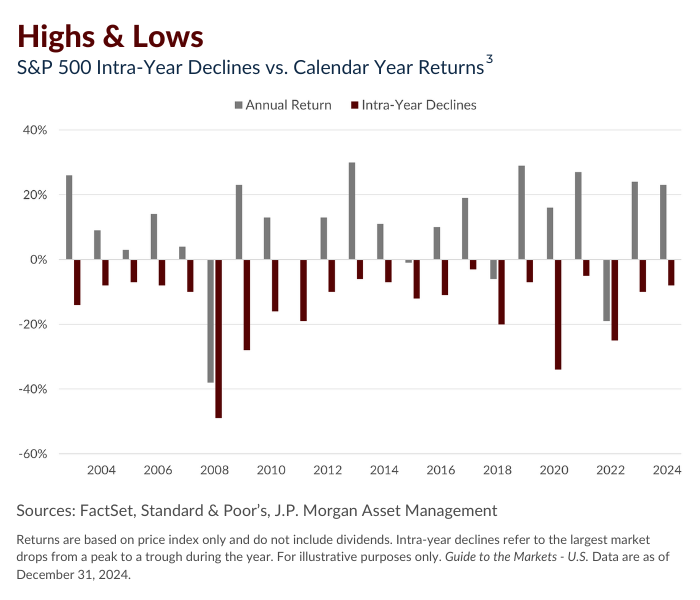
Looking back, we can see that intra-year declines are part of investing. For example, in 2024, stocks pulled back 8% over the course of the year en route to a strong 23% annual gain. Even the dramatic 34% plunge in 2020 didn’t prevent the market from recovering. These moments are a reminder of the market’s inherent volatility and resilience over time, but pullbacks will certainly test your mettle.
Remember, stocks don’t move in a straight line, and 2025 is shaping up to be another work in progress.2
Your portfolio was created to align with your goals, risk tolerance, and time horizon. However, when life circumstances change, it’s crucial to keep your financial advisor informed. Take control of your financial future by making more informed and proactive decisions rather than reacting to market fluctuations.
If you have questions about the current investment landscape and how it may impact your financial strategy, feel free to reach out. We can review your current plan, discuss any changes in your circumstances, and ensure you remain on track towards your goals.
1Wall Street Strategies, April 2, 2025. “Making Money with Charles Payne”
2J.P. Morgan Asset Management, 2025. “Guide to the Markets.“
3Stocks are measured by the Standard & Poor’s 500 (S&P 500) Composite Index, which is an unmanaged index considered to be representative of the overall U.S. stock market. Index performance is not indicative of the past performance of a particular investment. Individuals cannot invest directly in an index. The returns and principal values of stock prices will fluctuate as market conditions change. Shares, when sold, may be worth more or less than their original cost.