



When inflation makes headlines, the conversation usually stops at a single number. Prices went up 3 percent. Or 4 percent. But which number? Measured how? And by whom?
The truth is there’s no single “inflation rate.” The U.S. government publishes several, each built on different assumptions about who’s spending, what they’re buying, and how they adjust when prices shift. Understanding the differences could change the way you think about your own financial picture, because the only inflation rate that truly matters is the one you’re living with.
CPI: The Headline Number (and Its Lesser-Known Sibling)
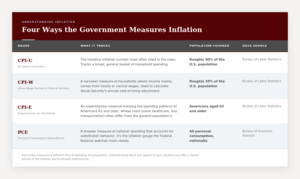
The Consumer Price Index for All Urban Consumers (CPI-U) is probably the inflation number you hear most. It tracks how prices change for a basket of goods and services—everything from groceries to medical visits to rent—and it covers over 90 percent of the U.S. population.1
But Social Security doesn’t use the CPI-U to calculate annual cost-of-living adjustments (COLAs). It uses the CPI-W—the Consumer Price Index for Urban Wage Earners and Clerical Workers. The CPI-W represents a narrower slice of the population, roughly 30 percent, and specifically covers households where at least one member works in an eligible wage-earning or clerical occupation. By definition, it excludes the spending patterns of retirees, the very people whose Social Security benefits it adjusts.1,2
CPI-E: An Experimental Index for Older Americans
Recognizing this gap, the Bureau of Labor Statistics developed the R-CPI-E, an experimental price index for Americans 62 and older. The key difference is how it weights spending categories. Older Americans tend to devote a substantially larger share of their budgets to medical care—roughly 12 percent of total expenditures, compared to about 7 percent for the general urban population. Because healthcare costs have historically risen faster than most other categories, the CPI-E has generally tracked slightly higher than both the CPI-U and CPI-W.2,3
The Senior Citizens League estimates that the CPI-E typically runs about two-tenths of a percentage point higher per year than the CPI-W. That may sound small, but over a 25-year retirement, it compounds. The organization estimated that a retiree who began receiving average benefits in 1984 would have collected roughly $13,700 more through 2011 if COLAs had been based on the CPI-E instead.4
$13,700more in COLA payments
1984–2011 · using CPI-E instead of CPI-W
This is a hypothetical example that compares the difference between CPI-Workers and CPI-Elderly. It’s an illustration created by the Senior Citizen League to estimate of the potential impact on long-term Social Security benefits. There is no guarantee that CPI-Elderly would continue to increase at a higher rate than CPI-Workers.
It’s worth noting that the CPI-E remains experimental. The BLS has flagged several limitations: the sample size is relatively small, the areas and retail outlets priced are based on the general urban population rather than older Americans specifically, and senior-citizen discounts may not be fully captured. Any conclusions drawn from it should be treated as tentative, but it raises important questions about whether the current COLA formula reflects the real costs retirees face. 3
PCE: The Federal Reserve’s Preferred Measure
While Congress looks at the CPI-W for Social Security, the Federal Reserve watches a different gauge altogether: the Personal Consumption Expenditures (PCE) Price Index. The Federal Open Market Committee has identified a 2 percent annual increase in the PCE as most consistent with its goals for maximum employment and price stability. 5
Why PCE over CPI?
The PCE covers a wider range of household spending and accounts for substitution behavior. If beef prices spike and consumers shift to chicken, the PCE reflects that change. The CPI, by contrast, tracks a more fixed basket. The PCE is produced by the Bureau of Economic Analysis and is published monthly as part of the Personal Income and Outlays report. 6
There’s also Core PCE, which strips out food and energy prices to reduce month-to-month volatility. Federal Reserve policymakers routinely examine these “core” measures because large price swings in food or energy in one period don’t necessarily signal a lasting trend. 5
Newer Tools on the Horizon
Official inflation data arrives with a lag—sometimes weeks after the period it covers. The Federal Reserve Bank of Cleveland addresses this with daily “nowcasts,” which estimate the current month’s inflation for both the CPI and PCE before the official numbers are published. Meanwhile, alternative trackers like Truflation aim to provide real-time inflation data drawn from a broader set of sources. These tools don’t replace official measures, but they offer additional perspective for those watching closely. 7
What This Could Mean for You
Here’s what all of this comes back to: none of these indices measure your inflation. As the BLS itself acknowledges, the CPI reflects the experience of the average household; it “seldom mirrors a particular consumer’s experience.” 1
If you spend more on healthcare than the typical household, your personal rate of inflation may run higher than the headlines suggest. If your energy costs are low, it may run at a lower rate.
A financial strategy that’s built around you may be better positioned to account for the inflation you actually experience, not just the one that makes the news. If you’d like to talk about how inflation fits into your bigger picture, don’t hesitate to reach out.
1. BLS.gov, September 2025.
2. BLS.gov, 2026.
3. BLS.gov, May 2026.
4. SeniorsLeague.org, 2026.
5. FederalReserve.gov, August 2025.
6. FRED.StLouisFed.org, April 2026.
7. ClevelandFed.org, May 2026.