

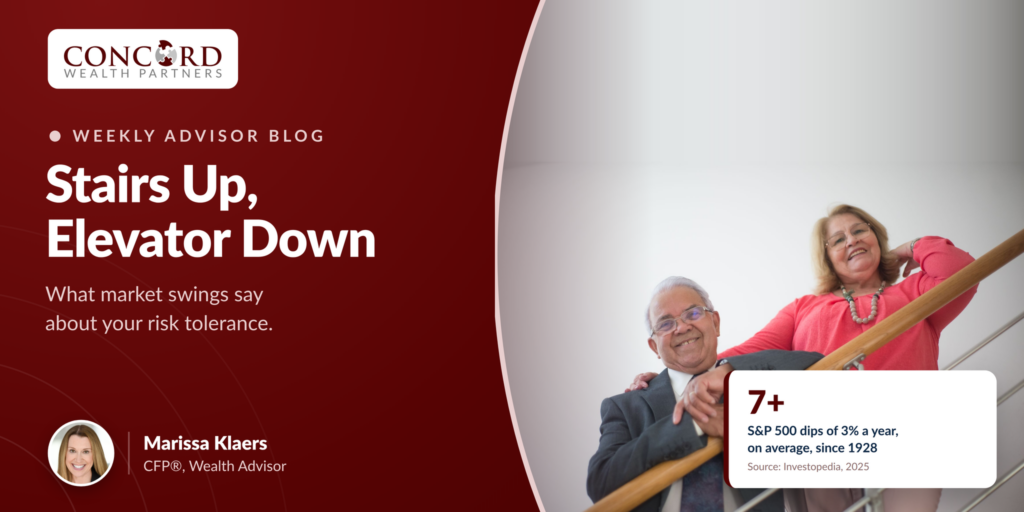

Stairs up, elevator down
Wall Street has a saying: stocks take the stairs up and the elevator down. Gains tend to build gradually, while declines can arrive fast and all at once.
Markets showed that pattern after the November elections. Stocks climbed right after the results, then dropped sharply the next day, led by technology and AI companies. Earlier in the year, a slower slide lasted a couple of months before the market recovered.
Part of the sharp drop came back within days. The exact numbers matter less than the shape: slow climbs, sudden drops, and partial rebounds, over and over.
Swings are normal, even in good years
Small dips of a few percent happen several times a year. Since 1980, nearly every calendar year has included a drop of 5% or more, and about half have included a drop of 10% or more. Bear markets, drops of 20% or more, are rarer still.
The chart below shows how often each size of decline has shown up historically.

Risk tolerance looks different on paper
Knowing that in theory is one thing. Living through a sharp drop is another. What felt fine on paper can feel very different when you wake up to red across your screen.
That reaction is useful information. If a recent drop made you want to sell, cost you sleep, or had you checking your accounts every hour, it’s worth asking whether your portfolio asks more of you than you’re comfortable giving. The best time to talk about it is now, while the feelings are fresh and no one is deciding in a panic.
If you’re starting to think, “This time it’s different,” please reach out.
We can review your overall strategy, with extra attention to your risk tolerance, and make sure your plan still fits the investor you are today, not just the one you were in a calm market.